Data tracker
Filter by
Chart of the month
Children entering care in England are increasingly likely to be boys
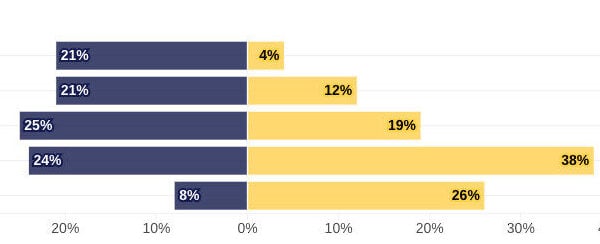
The profile of children entering care in England is changing. Since 2011, boys have made up an increasing share of entrants to care, rising from 53% to 61% by 2024. At the same time, we are also seeing higher number of older children entering care. These shifts matter because they point to changing patterns of need, with important implications for the services, accommodation and support available to children.
These changes have taken place against a backdrop of rising numbers of children entering care. According to a study published in June by Degli Esposti et al. (2026), which tracks children entering care in England back to 1971, entry rates began rising in 2005 after decades of decline. In 2024, 33,100 children entered the care of local authorities – one of the highest annual totals on record – although the numbers have flatlined in recent years.
The increase in the proportion of boys entering care has been accompanied by a shift in the age profile of entrants. Between 2011 and 2024, entry rates among those aged 16–18 increased by around 7.6% per year, while rates for younger children remained stable or fell. Taken together, the trends point to a growing representation of older children and boys entering care – groups that have historically been seen as less likely to be recognised as victims of harm and less likely to receive protective intervention.
One possible explanation is the rise in unaccompanied asylum-seeking children, who are predominantly male and usually aged 16 or over. However, the increase in care entries both predates and exceeds the growth in this population.
Alongside changes in who is entering care, there have also been changes in how children enter care. Voluntary (section 20) arrangements remain the most common route into care, but their share of entries fell from 73.8% in 2011 to 58.5% in 2024. Over the same period, entries via emergency protection orders rose from 1.7% to 9.7% of all entries, and interim care orders rose from 23.1% to 30.9%, both made by the family court. Most of this shift happened between 2016 and 2018, since which time the picture has been broadly stable.
It is important to note what the data cannot tell us. It does not show how routes into care vary by a child’s age or sex, nor whether the rise in emergency court-ordered entries is concentrated among older boys. However, for those providing care and support, the findings point to a shifting profile of need. Foster placements, children’s homes and support services developed around a younger and more evenly gender balanced population may be less well matched to a cohort increasingly made up of boys and older children, who have particular accommodation, education and relationship needs. The findings also raise questions about referral and intervention thresholds for boys and older children, who have historically been underserved groups when it comes to being recognised as at risk.
To find out more, see Degli Esposti et al. (2026), our previous piece Who’s in court? Who’s in care?, and DfE’s Children looked after in England including adoptions statistics.
The profile of children entering care in England is changing. Since 2011, boys have made up an increasing share of entrants to care, rising from 53% to 61% by 2024. At the same time, we are also seeing higher number of older children entering care. These shifts matter because they point to changing patterns of need, with important implications for the services, accommodation and support available to children.
These changes have taken place against a backdrop of rising numbers of children entering care. According to a study published in June by Degli Esposti et al. (2026), which tracks children entering care in England back to 1971, entry rates began rising in 2005 after decades of decline. In 2024, 33,100 children entered the care of local authorities – one of the highest annual totals on record – although the numbers have flatlined in recent years.
The increase in the proportion of boys entering care has been accompanied by a shift in the age profile of entrants. Between 2011 and 2024, entry rates among those aged 16–18 increased by around 7.6% per year, while rates for younger children remained stable or fell. Taken together, the trends point to a growing representation of older children and boys entering care – groups that have historically been seen as less likely to be recognised as victims of harm and less likely to receive protective intervention.
One possible explanation is the rise in unaccompanied asylum-seeking children, who are predominantly male and usually aged 16 or over. However, the increase in care entries both predates and exceeds the growth in this population.
Alongside changes in who is entering care, there have also been changes in how children enter care. Voluntary (section 20) arrangements remain the most common route into care, but their share of entries fell from 73.8% in 2011 to 58.5% in 2024. Over the same period, entries via emergency protection orders rose from 1.7% to 9.7% of all entries, and interim care orders rose from 23.1% to 30.9%, both made by the family court. Most of this shift happened between 2016 and 2018, since which time the picture has been broadly stable.
It is important to note what the data cannot tell us. It does not show how routes into care vary by a child’s age or sex, nor whether the rise in emergency court-ordered entries is concentrated among older boys. However, for those providing care and support, the findings point to a shifting profile of need. Foster placements, children’s homes and support services developed around a younger and more evenly gender balanced population may be less well matched to a cohort increasingly made up of boys and older children, who have particular accommodation, education and relationship needs. The findings also raise questions about referral and intervention thresholds for boys and older children, who have historically been underserved groups when it comes to being recognised as at risk.
To find out more, see Degli Esposti et al. (2026), our previous piece Who’s in court? Who’s in care?, and DfE’s Children looked after in England including adoptions statistics.
Most children in care in England are fostered – but the number of children’s homes is growing fast
Foster care (kinship and non-kinship) remains the mainstay of homes in England’s care system, but recent years have seen a steady decline: the number of approved foster carers in England fell 12% between 2020/21 and 2024/25 (63,890 to 56,345), alongside a 9% reduction in available fostering places. Over the same period, the number of children’s homes grew 50% (2,624 to 3,946) while the overall number of children in care increased only slightly (up 1%, from 80,780 to 81,770).
In 2025, 67% of children in care in England were in foster placements, 12% were in children’s homes, and the remainder were either in supported accommodation (9%), placed with parents or another person with parental responsibility (6%), in other placements (3%) or placed for adoption (2%). Mirroring trends in available places, the number of children living in foster care fell in the last year of available data (down 1,140 to 54,820 between 2023/24 and 2024/25), while the number living in children’s homes increased (up by 770 to 9,480 children). Since this data was collected, the number of children’s homes has continued to rise, reaching 4,747 by March 2026, according to Ofsted’s most recent release – a 20% increase in a single year.
Beyond the headline growth, the shape of children’s homes provision is also shifting. Homes are getting smaller – average capacity has fallen from 4.7 places in 2012/13 to 3.4 today – and the sector is increasingly privately owned, now accounting for 86% of all homes. Together, these trends point to a changing landscape: more children’s homes but ones that are smaller and increasingly commercial in character. Nuffield Family Justice Observatory’s own analysis of this year’s Ofsted data explores these shifts in more detail.
It is worth noting that foster care and children’s homes remain very different in scale – living in foster care is still over five times more common than living in children’s homes – but the direction of travel raises questions about the future capacity and shape of the care system. Trends also raise questions about matching, quality and costs as well as the lives and outcomes of children living in foster care and in children’s homes.
To find out more, see our Four key messages from Ofsted’s latest children’s social care statistics, Ofsted’s Fostering in England and Children’s social care in England releases, and DfE’s Children looked after in England including adoptions statistics.
Foster care (kinship and non-kinship) remains the mainstay of homes in England’s care system, but recent years have seen a steady decline: the number of approved foster carers in England fell 12% between 2020/21 and 2024/25 (63,890 to 56,345), alongside a 9% reduction in available fostering places. Over the same period, the number of children’s homes grew 50% (2,624 to 3,946) while the overall number of children in care increased only slightly (up 1%, from 80,780 to 81,770).
In 2025, 67% of children in care in England were in foster placements, 12% were in children’s homes, and the remainder were either in supported accommodation (9%), placed with parents or another person with parental responsibility (6%), in other placements (3%) or placed for adoption (2%). Mirroring trends in available places, the number of children living in foster care fell in the last year of available data (down 1,140 to 54,820 between 2023/24 and 2024/25), while the number living in children’s homes increased (up by 770 to 9,480 children). Since this data was collected, the number of children’s homes has continued to rise, reaching 4,747 by March 2026, according to Ofsted’s most recent release – a 20% increase in a single year.
Beyond the headline growth, the shape of children’s homes provision is also shifting. Homes are getting smaller – average capacity has fallen from 4.7 places in 2012/13 to 3.4 today – and the sector is increasingly privately owned, now accounting for 86% of all homes. Together, these trends point to a changing landscape: more children’s homes but ones that are smaller and increasingly commercial in character. Nuffield Family Justice Observatory’s own analysis of this year’s Ofsted data explores these shifts in more detail.
It is worth noting that foster care and children’s homes remain very different in scale – living in foster care is still over five times more common than living in children’s homes – but the direction of travel raises questions about the future capacity and shape of the care system. Trends also raise questions about matching, quality and costs as well as the lives and outcomes of children living in foster care and in children’s homes.
To find out more, see our Four key messages from Ofsted’s latest children’s social care statistics, Ofsted’s Fostering in England and Children’s social care in England releases, and DfE’s Children looked after in England including adoptions statistics.
Almost a third of parents in England, and two-fifths of parents in Wales, return to court in private law proceedings
In 2025, over 80,000 children were involved in private family law proceedings (Ministry of Justice, 2025). The majority of these cases will involve separated parents regarding arrangements for their children, coming to court for the first time. However, a small but substantial minority of parents return to court. When excluding ‘non-standard’ applications involving a non-parent, this makes up one-third of parents in England, and two-fifths of parents in Wales, returning for further proceedings within five years.
Recent research using Cafcass administrative data has shed light on the routes adults take to court in private law (Cusworth et al. 2026). It showed that roughly half of all applications involve a single standard application between two parents (45% in Wales, 54% in England). Roughly one-fifth of cases are for ‘non-standard’ applications, which feature non-parents as applicants or respondents (such as family members or step-parents) and may feature kinship care arrangements. A small minority (3%) are for adults that also have public law proceedings.
Most parents who return to court do so only once. But the research showed that 10% of parents in England and 14% in Wales are involved in more than two applications within five years. Analysis indicates that these parents return quickly, with typically less than two years between applications.
There are questions about the support needs and vulnerabilities of families who return to court, who are flagged in the data as facing greater challenges in relation to domestic abuse, mental health, drug and alcohol misuse as well as child welfare concerns. The recording of these flags may be more common because there is more contact with court and more chance to record challenges. However, the family justice system may also be missing opportunities to support such families – or decide on appropriate, sustainable arrangements – during their first set of proceedings.
This research was conducted using data collected before the initiation of child-focused courts. Further tracking is therefore needed to explore how reforms may impact families’ pathways.
To find out more about routes through court for families in private law proceedings, you can read the full report here.
In 2025, over 80,000 children were involved in private family law proceedings (Ministry of Justice, 2025). The majority of these cases will involve separated parents regarding arrangements for their children, coming to court for the first time. However, a small but substantial minority of parents return to court. When excluding ‘non-standard’ applications involving a non-parent, this makes up one-third of parents in England, and two-fifths of parents in Wales, returning for further proceedings within five years.
Recent research using Cafcass administrative data has shed light on the routes adults take to court in private law (Cusworth et al. 2026). It showed that roughly half of all applications involve a single standard application between two parents (45% in Wales, 54% in England). Roughly one-fifth of cases are for ‘non-standard’ applications, which feature non-parents as applicants or respondents (such as family members or step-parents) and may feature kinship care arrangements. A small minority (3%) are for adults that also have public law proceedings.
Most parents who return to court do so only once. But the research showed that 10% of parents in England and 14% in Wales are involved in more than two applications within five years. Analysis indicates that these parents return quickly, with typically less than two years between applications.
There are questions about the support needs and vulnerabilities of families who return to court, who are flagged in the data as facing greater challenges in relation to domestic abuse, mental health, drug and alcohol misuse as well as child welfare concerns. The recording of these flags may be more common because there is more contact with court and more chance to record challenges. However, the family justice system may also be missing opportunities to support such families – or decide on appropriate, sustainable arrangements – during their first set of proceedings.
This research was conducted using data collected before the initiation of child-focused courts. Further tracking is therefore needed to explore how reforms may impact families’ pathways.
To find out more about routes through court for families in private law proceedings, you can read the full report here.
The use of special guardianship orders has increased over the last 15 years
Special guardianship orders (SGOs) are a type of order made by the family court to carers (typically family or friends), granting them enhanced parental responsibility for a child until they turn 18. In 2025, 12% of children leaving care did so on SGOs and most of the 4,110 SGOs granted were to relatives or friends (90%) (DfE 2025). Overall, the use of SGOs has risen over the past 15 years, enabling children to live with their birth family, rather than being adopted or remaining in long-term foster care.
The routes to an SGO can be diverse. Predominantly, an SGO will result as an outcome of care proceedings, where family or friends have been identified as appropriate kinship carers for a child. A recent study on the characteristics of SGO families in Wales found that 70.3% of children were living with kinship foster carers immediately before the SGO was granted. However, it is also possible for a local authority to apply for an SGO order directly (although this is rare, with fewer than 250 each year). Family and friends can also apply for an SGO through private law proceedings, typically to formalise what may be an existing informal arrangement, with around 1,000 of these orders granted in private law proceedings each year.
The same study highlighted that there are inequalities among children who are likely to receive SGOs. Disabled children are less likely to receive an SGO, as are those from ethnic minority backgrounds. There was also variation in SGO use between local authorities, with some much more likely to use SGO arrangements than others. For families who look after children under special guardianship arrangements, the supports provided to them can vary. More linked data between education, social care and the family courts in England and Wales is needed to better understand the characteristics and needs of children and families on SGOs.
Special guardianship orders (SGOs) are a type of order made by the family court to carers (typically family or friends), granting them enhanced parental responsibility for a child until they turn 18. In 2025, 12% of children leaving care did so on SGOs and most of the 4,110 SGOs granted were to relatives or friends (90%) (DfE 2025). Overall, the use of SGOs has risen over the past 15 years, enabling children to live with their birth family, rather than being adopted or remaining in long-term foster care.
The routes to an SGO can be diverse. Predominantly, an SGO will result as an outcome of care proceedings, where family or friends have been identified as appropriate kinship carers for a child. A recent study on the characteristics of SGO families in Wales found that 70.3% of children were living with kinship foster carers immediately before the SGO was granted. However, it is also possible for a local authority to apply for an SGO order directly (although this is rare, with fewer than 250 each year). Family and friends can also apply for an SGO through private law proceedings, typically to formalise what may be an existing informal arrangement, with around 1,000 of these orders granted in private law proceedings each year.
The same study highlighted that there are inequalities among children who are likely to receive SGOs. Disabled children are less likely to receive an SGO, as are those from ethnic minority backgrounds. There was also variation in SGO use between local authorities, with some much more likely to use SGO arrangements than others. For families who look after children under special guardianship arrangements, the supports provided to them can vary. More linked data between education, social care and the family courts in England and Wales is needed to better understand the characteristics and needs of children and families on SGOs.
Children with longer-term permanence arrangements have better educational outcomes
Recent data shows that there are persistent gaps in educational outcomes for children both in and on the periphery of the family justice system – and there are large differences depending on care arrangements. Children who leave care on longer-term permanence arrangements (adoption or special guardianship orders), tend to do better at GCSE than their peers in care. 37% of children who are adopted, and 29% of those on special guardianship orders, have a passing grade in English and Maths, compared to 17% of those in care. However, this is still significantly below the achievement rate of 65%.
Stability (in both placements and relationships) is crucial for enabling children to achieve and close the gaps between them and their peers. Those who enter care during Key Stage 4 experience particularly high levels of disruption, and those who have been in care for less than 12 months have the poorest outcomes, with only 9% achieving a Grade 4 or above in English and Maths.
We also know that these inequalities begin in the early years. In 2024/25, 43% of children in care and 35% of children who had been in care for less than 12 months had a good level of development, compared to 68% of all pupils. By Key Stage 2, children in long-term care, those who have been adopted or who are on a special guardianship order are already falling behind their peers, with 35%–37% meeting the expected standard in reading, writing and maths, compared to 62% of all pupils. Children in need and those on child protection plans also fare poorly on measures across early years and throughout Key Stages 3 and 4.
Similar disparities have been observed in Wales, although detailed educational data is more limited. 42% of children receiving care and support achieve the core subject indicator at Key Stage 3 compared to 77% of all pupils. Further data is due to be released in Summer 2026.
Recent data shows that there are persistent gaps in educational outcomes for children both in and on the periphery of the family justice system – and there are large differences depending on care arrangements. Children who leave care on longer-term permanence arrangements (adoption or special guardianship orders), tend to do better at GCSE than their peers in care. 37% of children who are adopted, and 29% of those on special guardianship orders, have a passing grade in English and Maths, compared to 17% of those in care. However, this is still significantly below the achievement rate of 65%.
Stability (in both placements and relationships) is crucial for enabling children to achieve and close the gaps between them and their peers. Those who enter care during Key Stage 4 experience particularly high levels of disruption, and those who have been in care for less than 12 months have the poorest outcomes, with only 9% achieving a Grade 4 or above in English and Maths.
We also know that these inequalities begin in the early years. In 2024/25, 43% of children in care and 35% of children who had been in care for less than 12 months had a good level of development, compared to 68% of all pupils. By Key Stage 2, children in long-term care, those who have been adopted or who are on a special guardianship order are already falling behind their peers, with 35%–37% meeting the expected standard in reading, writing and maths, compared to 62% of all pupils. Children in need and those on child protection plans also fare poorly on measures across early years and throughout Key Stages 3 and 4.
Similar disparities have been observed in Wales, although detailed educational data is more limited. 42% of children receiving care and support achieve the core subject indicator at Key Stage 3 compared to 77% of all pupils. Further data is due to be released in Summer 2026.
Last year saw the steepest rise in private law applications in the last 10 years
Data released by the Ministry of Justice shows that in 2025, there were 16,349 new cases in public law proceedings (relating to 27,689 children), and 55,311 new cases in private law (relating to 81,809 children). In public law, this was a small increase of 2% in comparison to 2024. For private law, cases have increased 7% in comparison to 2024, which is this biggest annual increase in cases since 2015.
The number of public law applications remained steady in the final quarter of 2025 when compared to the same period in 2024, while the number of new private law cases went up by 13%.
Over the past decade, demand has fluctuated in the family courts, so we should be cautious about overinterpreting what may be behind relatively small variations in new cases. For the most recent rise in private law, suggested factors leading more families to court include the cost of living, diminishing social support and the increasing use of AI. However, it is too early to say if this increasing trend will last in the longer term, or whether we will see a stabilisation around these levels of demand.
To learn more about trends in the family justice system in 2025, read our blog.
Data released by the Ministry of Justice shows that in 2025, there were 16,349 new cases in public law proceedings (relating to 27,689 children), and 55,311 new cases in private law (relating to 81,809 children). In public law, this was a small increase of 2% in comparison to 2024. For private law, cases have increased 7% in comparison to 2024, which is this biggest annual increase in cases since 2015.
The number of public law applications remained steady in the final quarter of 2025 when compared to the same period in 2024, while the number of new private law cases went up by 13%.
Over the past decade, demand has fluctuated in the family courts, so we should be cautious about overinterpreting what may be behind relatively small variations in new cases. For the most recent rise in private law, suggested factors leading more families to court include the cost of living, diminishing social support and the increasing use of AI. However, it is too early to say if this increasing trend will last in the longer term, or whether we will see a stabilisation around these levels of demand.
To learn more about trends in the family justice system in 2025, read our blog.
There is variation in the use of section 20 across regions
A section 20 (s.20) care agreement is a voluntary arrangement under the Children Act 1989 allowing local authorities to provide accommodation for a child with the consent of those with parental responsibility. Across England, the use of these arrangements has increased. In 2024/25, 57% of children in England entered care under a voluntary agreement – an increase of 9% since 2019/20. Of all children in care (at 31 March 2025), 19% were accommodated under s20 (12% excluding unaccompanied asylum-seeking children).
Patterns of change to the frequency of s20 agreements differ across England and a number of factors may be driving these regional differences. For example, 98.5% of unaccompanied asylum-seeking children are accommodated under an s.20 agreement.
Some local authorities, such as those in the South East and London, have higher proportions of children in care who are unaccompanied asylum seekers, so are more likely to have high rates of s.20 usage. However, this does not explain all the variation, nor all the increase. In 2024/25, 18,240 children entered care under an s.20 agreement, however only 6,950 of them were unaccompanied asylum seekers. It is unclear how many of the remaining 11,290 children entering care on an s.20 agreement will remain on one – or how many convert to care orders, have a temporary period of care, or find other permanency.
Unanswered questions remain. Published data does not tell us the age or other characteristics of children on s.20 arrangements. Some usage may be linked to practices around newborn babies such as to avoid short-notice hearings immediately after birth. Or, it may link to older children entering care and local authorities recognising their responsibilities for young people presenting as homeless. More research is needed to understand which cases go to court, and which do not, the differences in children’s experiences and legal rights, and why practices around s.20 may differ across England.
A section 20 (s.20) care agreement is a voluntary arrangement under the Children Act 1989 allowing local authorities to provide accommodation for a child with the consent of those with parental responsibility. Across England, the use of these arrangements has increased. In 2024/25, 57% of children in England entered care under a voluntary agreement – an increase of 9% since 2019/20. Of all children in care (at 31 March 2025), 19% were accommodated under s20 (12% excluding unaccompanied asylum-seeking children).
Patterns of change to the frequency of s20 agreements differ across England and a number of factors may be driving these regional differences. For example, 98.5% of unaccompanied asylum-seeking children are accommodated under an s.20 agreement.
Some local authorities, such as those in the South East and London, have higher proportions of children in care who are unaccompanied asylum seekers, so are more likely to have high rates of s.20 usage. However, this does not explain all the variation, nor all the increase. In 2024/25, 18,240 children entered care under an s.20 agreement, however only 6,950 of them were unaccompanied asylum seekers. It is unclear how many of the remaining 11,290 children entering care on an s.20 agreement will remain on one – or how many convert to care orders, have a temporary period of care, or find other permanency.
Unanswered questions remain. Published data does not tell us the age or other characteristics of children on s.20 arrangements. Some usage may be linked to practices around newborn babies such as to avoid short-notice hearings immediately after birth. Or, it may link to older children entering care and local authorities recognising their responsibilities for young people presenting as homeless. More research is needed to understand which cases go to court, and which do not, the differences in children’s experiences and legal rights, and why practices around s.20 may differ across England.
White and Mixed ethnicity children are more likely to leave proceedings on legal permanence orders (adoption and special guardianship orders)
There are differences in the legal orders made in care proceedings according to a child’s ethnicity. White and Mixed ethnicity children are more likely to be placed for adoption than their peers from Black, Asian or Other ethnic groups. A higher proportion of children from Asian, Black and Other ethnic groups are subject to supervision orders or no order than children of other ethnicities.
The drivers of this variability remain unclear and require further research. It is likely that regional differences in judicial decision-making — particularly regarding the types of orders made — are partly shaped by other variations across geographic areas (including local ethnic makeup, levels of deprivation, poverty and social work practices). For example, areas where children have the highest risk of coming into care proceedings (such as the North East and North West), have higher rates of deprivation, less diversity and more children receiving care orders (47% of children in proceedings were placed on a care order in 2016/17 in these areas). Conversely, supervision orders have historically been more common in London, which has a higher percentage of Black and Asian children in proceedings, and may explain why these groups may be more likely to receive this outcome (Harwin et al. 2018).
More work is needed to understand how the variability of legal orders and ethnicity affect child outcomes. Children under some orders are more likely to have stability than others. For example, children on standalone supervision orders have the highest probability (20%) of returning to court within five years (Harwin et al. 2019). Children who leave care to be adopted or who are the subject of a special guardianship order, or who have been in care longer term, have better educational outcomes than those that face instability within the care system (Department for Education 2025).
See our research here for further details of ethnic inequalities and the family justice system, and on our data tracker.
There are differences in the legal orders made in care proceedings according to a child’s ethnicity. White and Mixed ethnicity children are more likely to be placed for adoption than their peers from Black, Asian or Other ethnic groups. A higher proportion of children from Asian, Black and Other ethnic groups are subject to supervision orders or no order than children of other ethnicities.
The drivers of this variability remain unclear and require further research. It is likely that regional differences in judicial decision-making — particularly regarding the types of orders made — are partly shaped by other variations across geographic areas (including local ethnic makeup, levels of deprivation, poverty and social work practices). For example, areas where children have the highest risk of coming into care proceedings (such as the North East and North West), have higher rates of deprivation, less diversity and more children receiving care orders (47% of children in proceedings were placed on a care order in 2016/17 in these areas). Conversely, supervision orders have historically been more common in London, which has a higher percentage of Black and Asian children in proceedings, and may explain why these groups may be more likely to receive this outcome (Harwin et al. 2018).
More work is needed to understand how the variability of legal orders and ethnicity affect child outcomes. Children under some orders are more likely to have stability than others. For example, children on standalone supervision orders have the highest probability (20%) of returning to court within five years (Harwin et al. 2019). Children who leave care to be adopted or who are the subject of a special guardianship order, or who have been in care longer term, have better educational outcomes than those that face instability within the care system (Department for Education 2025).
See our research here for further details of ethnic inequalities and the family justice system, and on our data tracker.
Publicly funded mediation has declined since 2013
Publicly funded mediation has seen a substantial decline since 2013, with a 60% drop in assessments over 12 years, and a halving of successful agreements.
This fall is frequently attributed to the removal of legal aid for most private law cases, as families were most often signposted to mediation through their lawyers. Following the Legal Aid, Sentencing and Punishment of Offenders Act (LASPO), the number of families starting mediation has remained low, however a small uptick in assessments in 2024/25 may indicate some change in this area. Initiatives such as the introduction of a voucher scheme in 2021 which offers up to £500 per family towards mediation costs, have not been properly tracked to establish whether they are effectively diverting families from court.
Mediation is not appropriate for all families and particularly may not be for families who have experienced domestic abuse, which is common in family court proceedings. Recent research by the Domestic Abuse Commissioner found that 87% of closed case files, and 73% of observed private law cases feature domestic abuse, indicating that a large proportion of families could be exempt from mediation. Between April 2019 and March 2024, only 35% of private law applicants attended a mediation information assessment meeting, as a large proportion claimed exemptions (NAO, 2025).
The decline in publicly funded mediation raises wider questions about how well families have access to appropriate guidance and support in the family courts, not just through mediation, but legal representation or otherwise. Efforts to divert families from court, or improve families’ experiences of feeling heard during proceedings, risk being undermined if early, adequately resourced forms of advice and assistance are not accessible.
Publicly funded mediation has seen a substantial decline since 2013, with a 60% drop in assessments over 12 years, and a halving of successful agreements.
This fall is frequently attributed to the removal of legal aid for most private law cases, as families were most often signposted to mediation through their lawyers. Following the Legal Aid, Sentencing and Punishment of Offenders Act (LASPO), the number of families starting mediation has remained low, however a small uptick in assessments in 2024/25 may indicate some change in this area. Initiatives such as the introduction of a voucher scheme in 2021 which offers up to £500 per family towards mediation costs, have not been properly tracked to establish whether they are effectively diverting families from court.
Mediation is not appropriate for all families and particularly may not be for families who have experienced domestic abuse, which is common in family court proceedings. Recent research by the Domestic Abuse Commissioner found that 87% of closed case files, and 73% of observed private law cases feature domestic abuse, indicating that a large proportion of families could be exempt from mediation. Between April 2019 and March 2024, only 35% of private law applicants attended a mediation information assessment meeting, as a large proportion claimed exemptions (NAO, 2025).
The decline in publicly funded mediation raises wider questions about how well families have access to appropriate guidance and support in the family courts, not just through mediation, but legal representation or otherwise. Efforts to divert families from court, or improve families’ experiences of feeling heard during proceedings, risk being undermined if early, adequately resourced forms of advice and assistance are not accessible.
There are more babies and young children in public law proceedings than in care
The majority of public law proceedings in the family courts are for younger children, in stark contrast to the population of children in care, where most are over the age of 10.
These differences can be partially explained by the outcomes for younger children in proceedings; a high proportion of cases involving children under a year old in England and Wales will result in adoption or a special guardianship order. There has also been an increase in older children in care, particularly those on voluntary or consent-based arrangements, who have not come through the family justice system (section 20 of the Children Act 1989 in England and section 76 of the Social Services and Well-being Act 2014 in Wales).
The majority of public law proceedings in the family courts are for younger children, in stark contrast to the population of children in care, where most are over the age of 10.
These differences can be partially explained by the outcomes for younger children in proceedings; a high proportion of cases involving children under a year old in England and Wales will result in adoption or a special guardianship order. There has also been an increase in older children in care, particularly those on voluntary or consent-based arrangements, who have not come through the family justice system (section 20 of the Children Act 1989 in England and section 76 of the Social Services and Well-being Act 2014 in Wales).
Vocational pathways into higher education are more common for care leavers
November is Care Leavers Month! In England and Wales, there are more than 50,000 care leavers aged 17-21. Care-experienced children and young people often face disrupted educational pathways, including household and school moves which can present barriers to continued education; 14% progress to higher education by age 22, compared to 56% of the general population.
For those entering higher education, a greater proportion (over a third) did so through vocational pathways (such as NVQ Level 3), rather than traditional pathways (entry with academic qualifications e.g. GCSE & A levels).
This data highlights the potential of flexible, vocational pathways to increase educational inclusion for young people with experience of children’s social care.
November is Care Leavers Month! In England and Wales, there are more than 50,000 care leavers aged 17-21. Care-experienced children and young people often face disrupted educational pathways, including household and school moves which can present barriers to continued education; 14% progress to higher education by age 22, compared to 56% of the general population.
For those entering higher education, a greater proportion (over a third) did so through vocational pathways (such as NVQ Level 3), rather than traditional pathways (entry with academic qualifications e.g. GCSE & A levels).
This data highlights the potential of flexible, vocational pathways to increase educational inclusion for young people with experience of children’s social care.
Mixed ethnicity children are overrepresented in kinship care
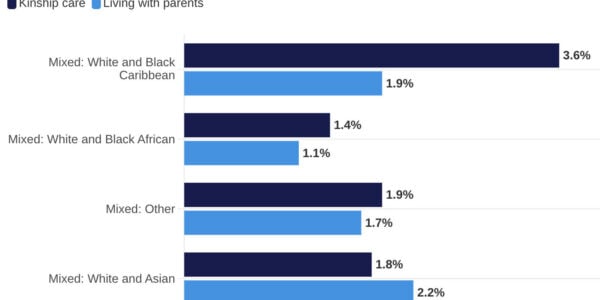
October marks Kinship care week! Kinship care is when a child is raised by relatives or friends, because their parents are unable to do so. According to the 2021 census, roughly 121,000 children were living in kinship care, and the majority of these children (59%) lived with at least one grandparent. Census data shows that Black and mixed ethnicity children are overrepresented in kinship care, compared to children living with their parents. This mirrors previous research in the family justice system, which has highlighted that these groups are over-represented in both the family courts, and in the care population.
The census captures information from nearly all households in England and Wales, so provides a picture of most children living in kinship care under a variety of different legal arrangements (such as kinship foster carers, special guardianship orders, or other informal arrangements that may not go through the family courts).
Read more about this data, and what it tells us about kinship families here.
October marks Kinship care week! Kinship care is when a child is raised by relatives or friends, because their parents are unable to do so. According to the 2021 census, roughly 121,000 children were living in kinship care, and the majority of these children (59%) lived with at least one grandparent. Census data shows that Black and mixed ethnicity children are overrepresented in kinship care, compared to children living with their parents. This mirrors previous research in the family justice system, which has highlighted that these groups are over-represented in both the family courts, and in the care population.
The census captures information from nearly all households in England and Wales, so provides a picture of most children living in kinship care under a variety of different legal arrangements (such as kinship foster carers, special guardianship orders, or other informal arrangements that may not go through the family courts).
Read more about this data, and what it tells us about kinship families here.
80% of cases in private family law proceedings involve at least one unrepresented party
Full legal representation is lacking in the majority of private family law cases, with 80% of cases involving at least one person who is unrepresented. The number of cases where neither applicant nor respondent has legal representation has risen substantially over the last decade, from 13% in 2013, to 39% in 2024. This increase was trigged by the introduction of the Legal Aid, Sentencing and Punishment of Offenders Act 2012, which resulted in the removal of eligibility for legal aid for the majority of private law cases, and came into effect in April 2013.
Access to legal aid in private family law is now restricted to cases where there are issues concerning domestic abuse or child abuse, in addition to stringent financial means testing. This has had knock-on effects, increasing pressures on the family courts as more applicants become litigants in person and require greater supports to navigate proceedings, as well as on other services such as community services or children’s social care when families struggle to resolve disagreements. Since May 2025 a cyber-attack on the Legal Aid Agency has further hampered access to justice, as systems remain offline and legal professionals are unable to be paid for legal aid work, adding additional strain on the system.
Full legal representation is lacking in the majority of private family law cases, with 80% of cases involving at least one person who is unrepresented. The number of cases where neither applicant nor respondent has legal representation has risen substantially over the last decade, from 13% in 2013, to 39% in 2024. This increase was trigged by the introduction of the Legal Aid, Sentencing and Punishment of Offenders Act 2012, which resulted in the removal of eligibility for legal aid for the majority of private law cases, and came into effect in April 2013.
Access to legal aid in private family law is now restricted to cases where there are issues concerning domestic abuse or child abuse, in addition to stringent financial means testing. This has had knock-on effects, increasing pressures on the family courts as more applicants become litigants in person and require greater supports to navigate proceedings, as well as on other services such as community services or children’s social care when families struggle to resolve disagreements. Since May 2025 a cyber-attack on the Legal Aid Agency has further hampered access to justice, as systems remain offline and legal professionals are unable to be paid for legal aid work, adding additional strain on the system.
Over half of school-aged children in care have special educational needs
Special educational needs (SEN)s encompass a range of needs and disabilities including neurodivergence (such as ADHD and Autism), cognitive, socio-emotional and mental health difficulties, physical disabilities and sensory difficulties. A high proportion of children in care have SEN. As the graph shows, over half (57%) of children in care have special educational needs, compared to 18% of all children. This suggests that approximately 3% of all children with special educational needs are those in care, around four times higher compared to the percentage of children in care in the general population (less than 1%). Since 2017/18, the number of children with special educational needs has steadily increased, with a sharper rise among looked after children (4.7%) compared to all pupils (3.5%).
Special educational needs (SEN)s encompass a range of needs and disabilities including neurodivergence (such as ADHD and Autism), cognitive, socio-emotional and mental health difficulties, physical disabilities and sensory difficulties. A high proportion of children in care have SEN. As the graph shows, over half (57%) of children in care have special educational needs, compared to 18% of all children. This suggests that approximately 3% of all children with special educational needs are those in care, around four times higher compared to the percentage of children in care in the general population (less than 1%). Since 2017/18, the number of children with special educational needs has steadily increased, with a sharper rise among looked after children (4.7%) compared to all pupils (3.5%).

Infographic
What do we know about children in the family justice system?
Our regularly updated infographic highlights what we know, and what we don’t know, about children’s journeys through the family justice system based on national administrative data.